The “Kiwi drift” is the elephant in the room in the Church in New Zealand, according to the Bishop of Auckland, Bishop Patrick Dunn.
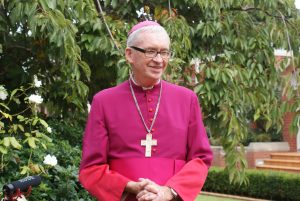
Auckland Bishop Patrick Dunn
Bishop Dunn, the president of the New Zealand Catholic Bishops Conference, defined Kiwi drift as “the haemorrhage of New Zealand-born or New Zealand-bred people from the Church”.
“It is affecting all our parishes,” he said in his bishop’s forum talk at St Thomas More Church at Glenfield on May 11. “Welcome to the most exciting and the most critical mission for the Church in the 21st century. This is it.”
Bishop Dunn noted that the number of Massgoers has been steady, but attributed that to the influx of migrants.
Quoting Massey University professor of history Peter Lineham, Bishop Dunn said that in Auckland, “we’re ‘significantly deceived’”.
“We’re not sort of aware of this [Kiwi drift] because many of our Churches are packed. But when you look around, where are the Kiwis?” he asked.
Bishop Dunn said all is not lost, but there is a need to examine this reality. “If we can try and understand why that is going on in our society, if we’ve got some idea of what’s happening, then we’ll feel empowered, as it were, in how we can respond,” he said.
The first theory he put forward was the “collapse of Christendom”, or the “disengagement of the Gospel and culture”.
The rise of Christianity came about with the conversion of Emperor Constantine in AD313, when government, culture and the Gospel came together.
In the past, religious education had been unnecessary because religion and culture were intertwined.
However, the bishop noted, religion and culture had been coming apart in the past 200 years.
”In the 1960s, society changed [with] television, student revolt, sexual revolution, drugs. The whole change just became rapid and [culture and Gospel] disentangled,” he said.
Although this may not be true in some countries, the disengagement of culture and faith happened here, he added.
At the same time, Bishop Dunn said, spirituality is being seen as distinct from religion.
Bishop Dunn said that when La Trobe University professor David Tacey suggested to university officials that he offer a course in spirituality, they were sceptical.
“The university officials thought young people weren’t interested in religion,” said Bishop Dunn. “Religion, no, but spirituality… It is the most popular course on campus.
“We are all familiar with people saying I’m a spiritual person, but I’m not religious. Religion is associated with hypocrisy, homophobia, abuse, terrorism in the case of ISIS. Whereas spirituality is associated with the inner self, nature, appreciation for nature, environment, appreciation of culture.”
This makes the mission of spreading the Gospel challenging and critical at this stage, he said.
“Pope Francis says it’s not an era of change, it’s a change of an era. It’s like a whole new age and we’re the ones that are at its crossroad point. It’s a privilege, but it’s also a challenge. It’s pretty scary, Kiwi drift. And yet, it’s not all bad news,” said Bishop Dunn.
He said it is important to be aware of the importance of the Church in society as an institution. Last year, Auckland diocese was one of the top five institutions in terms of volunteering.
“Would the city of Auckland be better if there were no churches or synagogues? Would society be enriched? I’m not sure,” he said.
Bishop Dunn added it is important to nourish our faith as culture and Gospel disconnected.
He also reminded parishioners, “New Zealand is not Europe. We are so mixed. We’ve got the influence of Oceania and Asia. It’s a beautiful mix.”

One of the reasons is poor catechesis for decades.
Why stay if even your parents don’t know what is important about being Catholic.
Poor Liturgies don’t help either.
Exactly – watered down Church Teaching, avoiding the “hard to hear” teachings of the Church eg Death, Judgement, Heaven, Hell, Plus false ecumenism, poor and even scandalous liturgies. If the issue was the time period we now live in, then the places and communities where the Traditional Latin Mass is said and where the Traditional Catholic Teachings were upheld would not have increasing numbers. Unfortunately the Bishops of NZ have their heads in the sand…and sadly at the expense of thousands of souls.
Returning to the centuries old practices, teachings, the Traditional Mass etc of the Catholic Faith is the only solution to reverse the crisis.
Patrick Dunn is a very good man.
New Zealanders should be grateful that he has offered this insight.
The Catholic church all over is suffering these problems.
Tens of millions of pilgrims have visited a small Franciscan parish of Medjugorje from all over the world to hear the vital statistics :
Prayer, fasting, leading simple lives, and being reconciled to God each day.
Youth are supposed to navigate, but can’t. Between surf boards and other
distractions they eventually settle into a complacent matrimony dictated to by
the visual media, instead of the church.
So the answer is as always, return to the basics, and “abandon yourselves totally to me”
the call from above. Mother of Perpetual help.
The move must always be to turn inwards, to the inner way, the centre of all Christians
which is Christ.
When Christ is the motivator, the whole community changes.
The bread has a leaven, and it rises.
The world is in a denial of Christ, and this is the challenge of evangelism.
A spark has entered the church, and now it is a raging fire, and it is called catholic charismatic renewal.
https://www.youtube.com/watch?v=xWcujx1II2w
If the Pope receives why not the flock?