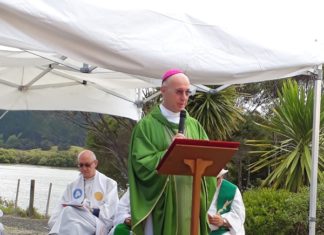





MADRID, Spain (CNS) Catholic leaders criticised the Spanish government’s plans to make abortion more accessible by late next year. Cardinal Agustin Garcia-Gasco Vicente of Valencia said in a Sept. 11 homily it was "fraud to utilize the name of liberty and democracy to extend the license to kill."
"To promote abortion … is to promote death; it is to bet on violence, not on peace; it is to extend sickness, not cure or generate health," he said.
The same day, Bishop Antonio Dorado Soto of Malaga accused the government of wanting to change the abortion law to deflect attention from the country’s economic problems. He told the Spanish radio station COPE that the economic situation in Spain is not as serious as the need to defend life.
The current law, in effect since 1985, allows abortion in cases of rape until the 12th week of pregnancy, if the fetus is unhealthy until the 22nd week or if the pregnancy threatens the health of the mother at any time.
Most abortions in Spain are performed in private clinics, which excludes women who cannot afford the procedure. In some communities, such as Navarra in the north, abortion is not legal.
Equality Minister Bibiana Aido, who announced plans for the government’s new legislation in early September, publicly criticized the existing law.
"It cannot be that in Spain a woman who decides to interrupt her pregnancy has a different treatment depending on … the community" she lives in, Aido said.
The Spanish government proposal is still being written and will be turned over to the Spanish Parliament for a vote in 2009. It would incorporate international legislation on abortion and allow women to abort for any reason.
In a Sept. 14 letter, Cardinal Lluis Martinez Sistach of Barcelona wrote that such a law would double the number of abortions in Spain. An estimated 100,000 abortions occur annually in the country.
"The degree of humanization of a society can be measured above all through the respect … its laws (show to) human life," Cardinal Martinez said, pointing out that the Spanish Constitution says that "everyone has a right to life."
Cardinal William J. Levada, prefect of the Congregation for the Doctrine of the Faith, said after Aido’s announcement that the proposal saddened him because "the vision of created life, the precious dignity of every person that starts with conception, is not at the base of the project."
Cardinal Levada said Pope John Paul II’s 1995 encyclical, "Evangelium Vitae" ("The Gospel of Life"), refers to abortion as "not a solely political question, but something religious and cultural that touches the roots of humankind" and "deserves dialogue with the greatest attention to the history of the issue."