











by NEVIL GIBSON
From 1982s cute extra-terrestial ET to the clunky robots of This Island Earth and Fantastic Planet back in the 1950s, aliens have seldom been far from the big screen.
The biggest flop in recent times was Walt Disney’s John Carter, while the alien-minders of Men in Black are back for the third time since their first appearance in 1997.
Although relatively low budget, Alien scored big time in the shock stakes with slithery, spurting creatures that horrified and enthralled audiences at the same time.
The series degenerated over time with the sequels. But like Men in Black 3, director Ridley Scott has returned, 33 years later, to fill in the gaps: Where did these creatures come from and why are they so bent on destruction?
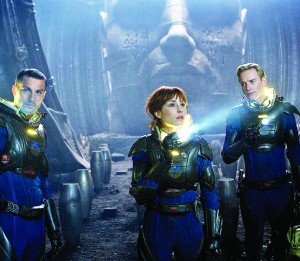
The reasons are not as profound as you might imagine, although Prometheus (20th Century Fox) loads a 3D special-effects blockbuster with portentous explanations that the origins of mankind could lie on a moon some several years away.
Any significance in God’s role in creation is underlined by the savvy heroine and archaeologist (Noomi Rapace), who prominently wears a cross around her neck.
She and her co-researcher (Logan Marshall-Green) have discovered, towards the end of the 21st century, that a series of ancient cave drawings could point to this far-off civilisation.
But before that, we see an advanced humanoid throw himself over a huge waterfall after consuming some destructive matter.
All three are destined to meet up again as the archaeologists join a space mission, financed by a private corporation, that takes them to the habitable place indicated in the drawings.
Events soon get out of hand for the the mission members, who also include an enigmatic android brain box (Michael Fassbender) and an equally enigmatic mission leader (Charlize Theron), who in turn has shadowy corporate employers.
Neither can be completely trusted, while some of the others should have been rejected at the start.
The plot soon deepens as the special effects take over and Ridley’s hairbrained ideas go wild with irrelevant details, confused motivations and Lord of the Rings-sized caverns (thanks again, Weta Digital) full of strange urns, a giant head and lots of nasty beasties — plus the super humanoid, who is the last of his civilisation — or something.
During a series of climaxes, in which possible endings are considered and rejected, the slimy, dagger-teethed aliens (designed by H. R. Giger) reappear and start wiping out most of the spaceship crew.
It wouldn’t be a Ridley Scott film without a major shock, and this is delivered on an automated medical operating table as Rapace puts herself at the mercy of surgical robots and recovers her cross (taken away by the double-dealing Fassbender).
The mystical and religious themes blossom, along with the enormity of the forces pitched against the puny but intrepid travellers from earth, leaving the viewer stunned but befuddled.
Restricted to audiences over 16; 124 minutes.
Aliens befuddle space blockbuster


Featured News
- All
- Catholic Events
- Catholic News
- Featured
- Featured Catholic News
- International Catholic News
- New Zealand Catholic Opinion
- News
- Reviews New Zealand Catholic
More

Emergency housing provider James Liston Hostel to be upgraded
The James Liston Hostel, the only emergency housing provider in Auckland’s city centre, will be getting a $4 million refurbishment that will start in March and will be completed...