

by PAT McCARTHY
Come all ye faithful, come ye to Bethlehem — to the underground cave where Jesus was born.
Cave? What about the wooden-framed stable so beloved of Christmas card artists and Nativity crib creators?
Yes, cave. Far from the Christmas-card images, Jesus was born below ground level, in a natural limestone cave.
Even today in the Judean hills, some families live in primitive houses built above natural caves used for storage or to shelter animals — whose breath helps heat the house in winter, when there can be the odd snowfall. Extra rooms are hewn out of the soft limestone.
According to the most ancient tradition, it was in one of these caves that Mary gave birth to her Son. She laid him in a manger — a feeding trough — also carved out of rock, because wood was a scarce building material.
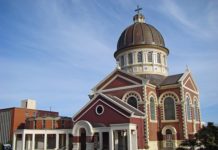
Today the cave of Jesus’ birth is called the Grotto of the Nativity. Over it, about 345 years after the first Christmas, the Roman emperor Constantine the Great built the Church of the Nativity.
The church we see today, a fortress-like building reconstructed in the sixth century, is the oldest surviving complete church in the Christian world.
To travel to the West Bank city of Bethlehem from Nazareth would not be easy today for Mary and Joseph.
Israel’s concrete security wall, eight metres tall, stands in the way. A Jewish couple would be turned away, unless they had a special permit.
The only Israeli citizens normally permitted to enter Bethlehem are soldiers and, since last year, tour guides.
As our pilgrimage bus halts before a checkpoint, two young soldiers — they look like teenagers, male and female — climb aboard, machineguns hanging casually from their shoulders.
It’s just a passport check and the soldiers are friendly, even posing for photos with pilgrims.
But Palestinian cars pulled up on one side of the road are getting a tougher scrutiny — even underneath, using a mirror on a long handle.
Having passed inspection, our bus is waved through the checkpoint, past an Israel Ministry of Tourism poster declaring “Peace be with you”.
Graffiti and art, often poignant, decorate Bethlehem’s side of the wall. The slogan “Bridges not walls” echoes sentiments expressed by Popes Benedict XVI and John Paul II.
The guns and the checkpoint remind us that historical Palestine was a place of invasion and occupation long before the Prince of Peace was born in Bethlehem under Roman rule.
Armies of the Babylonians, Persians, Greeks, Romans, Crusaders, Mamluks, Ottoman Turks and British have trodden this soil.
More relevant to our pilgrims’ purpose, Bible history has been written all around us.
Not far away is Shepherds’ Field, where an angel brought tidings of joy to men who watched their flocks by night. Nearby is the Field of Boaz, great-grandfather of King David, who let Ruth glean his barley and then fell in love with her.
Soon we are in the narrow streets of Bethlehem, cream-stone buildings on either side.
A woman in a hijab sits behind boxes of vegetables at a streetside stall. Outside a café, four men huddle over a backgammon board. Gnarled branches of olive wood are propped against the wall of a workshop where souvenirs are carved.
Leaving our bus, we walk across a broad paved area — yes, this is Manger Square. On one side, the tall minaret of the Mosque of Omar brings home one of the modern realities of Bethlehem: The birthplace of Jesus, once a Christian town, is now a Muslim city.
In recent decades, for economic and political reasons, Christians have emigrated in their thousands. There are now more Christians from Bethlehem living in Santiago, Chile, than there are left in Bethlehem.
Among the Christians there are Catholics of the Latin (that is, Roman), Syrian, Melchite, Armenian and Maronite rites. The Orthodox are Greek, Syrian and Armenian. And there are Protestants of several denominations.
We cross Manger Square. Ahead is a grey building whose weathered stone frontage gives it the look of a medieval fortress.
This un-churchlike pile is the Basilica of the Nativity. It escaped destruction by invading Persians in the seventh century only because the invaders saw a mosaic depicting the Three Wise Men in Persian dress.
The doorway surprises pilgrims. Now only 1.2 metres high, it was lowered around the year 1500 to prevent looters driving their carts in.
As we stoop to enter the Door of Humility, as it is called, we reflect on how low Jesus stooped to enter humanity.
Inside, the church is cool and dark, with impressive rows of red limestone pillars lining either side. There are no pews, but trapdoors in the floor give glimpses of the mosaic floor of Constantine’s basilica.
Along the right side, tourists and pilgrims are queuing to visit the underground Grotto of the Nativity.
Our guide shepherds us into line as we look around at faded Crusader paintings on the pillars and fragments of mosaics on the walls, some depicting early Church councils and their decrees.
This is now essentially a Greek Orthodox church, with some parts in Armenian Orthodox and Catholic possession — as laid down by a formula set in stone during Ottoman Turkish rule in 1853.
So while Western Christians celebrate Jesus’ birthday on December 25, the church at his birthplace still has 13 days to wait for the Orthodox observance on January 7 and a further 12 days for the Armenian Christmas.
The queue is moving slowly, so there’s time for a handful of us to slip away into the adjacent Church of St Catherine of Alexandria. This more modern Catholic church is where Bethlehem’s midnight Mass on Christmas Eve is beamed worldwide to television viewers.
Descending a narrow staircase on the righthand side, we reach a series of underground cave chapels.
Two are of particular interest. The Chapel of the Holy Innocents is said to be the burial place of the infants killed by Herod the Great in his attempt to eliminate the newborn “King of the Jews”.
The two-roomed St Jerome’s Cave — living quarters and study — is where this scholarly Dalmatian priest spent 30 years translating the Bible from Hebrew and Greek into the Latin version known as the Vulgate.
Returning to the Nativity church, we rejoin our companions in the queue. Meanwhile, tourist buses have disgorged another throng of visitors.
Jerome, crusty old Dally that he was, would not have approved. He even had a jaundiced view of the pilgrims who were flocking to Bethlehem in the third century.
“They come here from all over the world, the city regurgitates every type of human being; and there is an awful crush of persons of both sexes who in other places you should avoid at least in part but here you have to stomach them to the full,” said he.
Reaching the front of the church, we pass to the right of the iconostasis, the carved screen that stands in front of the main altar, and descend a circular staircase. Down we go to the subterranean cave of Jesus’ birth.
The room-sized cave is rather drab, dimly-lit and gloomy, the ceiling blackened by lamp and candle smoke. Following a serious fire in 1869, three of the rough rock walls are hung with heavy leather drapes backed with asbestos.
On the floor at one side, under a small altar and a dozen hanging lamps, a 14-point silver star on the marble floor bears the words “Hic de Virgine Maria Jesus Christus natus est” (Here Jesus Christ was born to the Virgin Mary).
This is the place of Mary’s “home birth”. Was there a midwife (an ancient tradition identifies one called Salome)? Did Mary feel pain? What did Joseph the builder do? Were there animals in the cave? We know none of these things.
Pilgrims take turns to prostrate themselves and kiss the star of Bethlehem.
Close by, and a few steps down, is the Grotto of the Manger, a Catholic chapel. The rock shelf has been covered with marble, but the original rock may be seen around it. The dimensions of the manger match those of feeding troughs cut into rock by local Bedouins.
To Western eyes, the whole area is ostentatiously decorated: Velvet and brocade coverings drape the walls; oil lamps in profusion hang from the ceiling; fragments of old paintings and mosaics complete the cluttered effect.
New Zealand biblical scholar E. M. Blaiklock put it well when he described the cave as “hung and cluttered with all the tinsel of men’s devotions”.
We cannot linger long. Encouraged by a Greek Orthodox priest and traffic controller, we climb a matching staircase on the other side of the church and return to ground level.
But we have been to the place of Jesus’ birth, and the aura of that place will remain with us. The Gospel reading at Christmas Mass will forever hold new meaning.
— Pat McCarthy, founding editor of NZ Catholic and director of the website www.seetheholyland.net, will lead a pilgrimage to the Holy Land, including Bethlehem, next September.
Underground in the cave of Bethlehem

Featured News
- All
- Catholic Events
- Catholic News
- Featured
- Featured Catholic News
- International Catholic News
- New Zealand Catholic Opinion
- News
- Reviews New Zealand Catholic
More
Priest who died at Christmas was buried on birthday
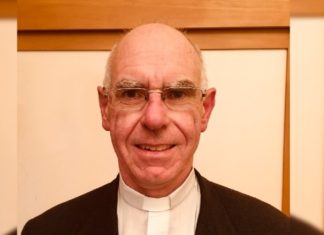
Auckland priest Fr Patrick (Paddy) Collins died on Christmas Day and was buried four days later on what would have been his 86th birthday.
At a Requiem Mass at St...


Regarding the Israeli checkpoints and as a just returned Catholic with an interest in Israel, I would like to comment on Israeli checkpoints. I would have been happier if you had included the reason why Israel finds it necessary to have checkpoints and mentioned the suicide bombers before the wall. Has Israel no right to protect its citizens against indoctrinated extremists who send children and donkeys laden with bombs to kill innocents? Every country in the world has passport and security checks, even our own despite being surrounded by water and far from any conflict. Israel is surrounded by Muslim countries whose one desire is to destroy the one democratic (MMP like us with Arabs in parliament) country with a diverse ethnic and religious (20 percent Arab) population.
Please read this article: Seasonal Illwill and also some of the others on the Kiwis for Balanced Reporting in the Middle East web site.
I could write so much more. I could ask if you know why the Jews who fled Arab lands because of persecution were absorbed into Israel, while the Arabs who fled Israel (Jordanians) were called Palestinians and kept as refugees after 1948? Jews were known as Palestinians before 1948. There was no Palestinian race of people nor criteria which makes a people as such. No Palestinian language, history lands. Meanwhile Palestinian propaganda and media misinformation flourish, all aiming to destroy Israel, the country instigated legally by a vote of nations. The Bible is a record of the Jews presence in the land. Hebrew is the language of Jews kept throughout the persecution down the years.
There is a saying: Lies fly while truth struggles beneath its load.
Lea Hullett
Your views are clearly strongly held, Lea, and fair enough. However, I think they may be a bit misapplied in this case. The article you are responding to is not political — I read nothing political in it. It is, I believe, an accurate report of a significant part of a religious pilgrimage.
— Editor
I support Lea’s article answering the subtle allegations. Jew Hatred and Shahada for Allah, is taught in Judea and Samaria to Arab children from Kindergarten upwards, hence a fence to prevent suicide bombers entering Jerusalem and missing out on 72 virgins in paradise as their prize, plus preserving Jewish lives. Many countries in the world have separation fences or walls, Israel is certainly not unique in that. Jew Hatred even exists among some Arab Christians taught in a Church school in Bethlehem, as I have heard in a Bethlehem born Arabs testimony. As a Christian I too have been to Bethlehem, but was not impressed with so called Christians worshipping shrines, or the regular broom fights among clergy, that also applied to the Holy Sepulchre in the Old City, I found swooning activites there by folk sickening, hence I didn’t feel to go further inside than the entrance hall. We are called to worship God, and live and walk daily in relationship [not religion or ritual] with the RISEN Jesus. This site along with many others are assumed sites , a Messianic Jewish friend told me if we knew the correct sites, they would be worshipped rather than Jesus. Doesn’t the Bible warn about doing that? Isn’t it worshipping idols, statues and buildings.
Jan, I have not approved your comments as I think they are either defamatory of the author, or are close to it.