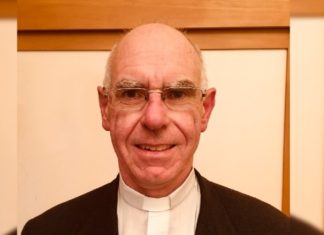









AUCKLAND A New Zealand canon lawyer has questioned whether many people raised and formed in modern Western cultures can marry validly in the eyes of the Church. Writing in the January edition of The Canonist (journal of the Canon Law Society of Australia and New Zealand) Fr Anthony Malone, OFM, posed the question: In societies where personal autonomy and self-fulfilment are held as ideals and where, as a result, individualism and moral relativism are normative for behaviour, can individuals so enculturated marry validly?
The answer is a qualified no, Fr Malone concluded.
In laypeoples terms, many people are raised and formed in a culture where selfishness and having your own way all the time are held up as ideals and this deeply penetrates their personalities and outlooks.
This culture or superculture is diametrically opposed to the essential elements of marriage as understood by the Church, Fr Malone wrote.
These elements include a perpetual and exclusive bond between spouses and a partnership ordered to the good of spouses and procreation of children.
But being formed in permissive, self-fulfilling modern Western culture means many can be radically in error about what consenting to marriage entails before doing so, even if done in all sincerity.
Fr Malone wrote that judges in church courts considering marriage annulments are aware of the supercultures effects on an individuals capacity to consent fully to marriage.
While the presumption of the Church’s courts is always in favour of the validity of a marriage, this can yield to proof of an established radical error affecting the fullness of the consent given.
This error is difficult to establish with moral certitude, Fr Malone added.
The mindset of the individual(s) concerned might only be able to be deduced by the Church’s judges from background, observable behaviour and values expressed through language.
Background factors the cultural acceptance of no-fault divorce, the phenomenon of the baptised non-believer, premarital cohabitation, lack of pre-marriage preparation can all point to a problem in giving a valid consent.
There are about 80 annulments of marriages each year granted by the Church tribunal in New Zealand. Such a declaration means that the marriage was not one regarded in Church law as permanent, that is, binding until the death of one of the spouses, Fr Malone said.
Fr Malone is associate judicial vicar of the Regional Tribunal of the Catholic Church in New Zealand and director of the Auckland and Hamilton offices of the New Zealand tribunal. He is also a judge at the Appeal Tribunal of the Catholic Church in Australia and New Zealand.
Early in May, Statistics New Zealand figures showed the rate of marriage is one third of what it was in 1971.
About one third of couples who married 25 years ago are now divorced.
But the divorce rate is the lowest in 29 years.
Fr Malone told NZ Catholic the divorce rate for Catholics is about the same as that for the general population.
Culture causes doubts about marriage today
Featured News
- All
- Catholic Events
- Catholic News
- Featured
- Featured Catholic News
- International Catholic News
- New Zealand Catholic Opinion
- News
- Reviews New Zealand Catholic
More
Priest who died at Christmas was buried on birthday
Auckland priest Fr Patrick (Paddy) Collins died on Christmas Day and was buried four days later on what would have been his 86th birthday.
At a Requiem Mass at St...