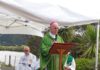




VATICAN CITY Celebrating Christmas Mass in St Peter’s Basilica, Pope Benedict XVI spoke about a modern tendency to be tone deaf to God. Christmas, he said, reminds people that God is the highest priority.
But rather than reveal himself with an astonishing miracle or an imposing sign of power and greatness, Gods sign at Bethlehem is his humility, the pope said.
The Christmas Mass began with a security incident as the pope processed into the basilica. A woman jumped the barriers separating the crowd from the pope and briefly knocked the 82-year-old pontiff to the ground, according to Vatican spokesman Father Ciro Benedettini.
The pope was unharmed and quickly rose to his feet and continued down the main aisle to the altar, as applause rang out in the basilica.
An English translation of the Pope’s homily follows:
A child is born for us, a son is given to us (Is 9:5). What Isaiah prophesied as he gazed into the future from afar, consoling Israel amid its trials and its darkness, is now proclaimed to the shepherds as a present reality by the Angel, from whom a cloud of light streams forth: To you is born this day in the city of David a Savior, who is Christ the Lord (Lk 2:11). The Lord is here. From this moment, God is truly God with us. No longer is he the distant God who can in some way be perceived from afar, in creation and in our own consciousness. He has entered the world. He is close to us. The words of the risen Christ to his followers are addressed also to us: Lo, I am with you always, to the close of the age (Mt 28:20). For you the Savior is born: through the Gospel and those who proclaim it, God now reminds us of the message that the Angel announced to the shepherds. It is a message that cannot leave us indifferent. If it is true, it changes everything. If it is true, it also affects me. Like the shepherds, then, I too must say: Come on, I want to go to Bethlehem to see the Word that has occurred there. The story of the shepherds is included in the Gospel for a reason. They show us the right way to respond to the message that we too have received. What is it that these first witnesses of Gods incarnation have to tell us?
The first thing we are told about the shepherds is that they were on the watch they could hear the message precisely because they were awake. We must be awake, so that we can hear the message. We must become truly vigilant people. What does this mean? The principal difference between someone dreaming and someone awake is that the dreamer is in a world of his own. His self is locked into this dreamworld that is his alone and does not connect him with others. To wake up means to leave that private world of ones own and to enter the common reality, the truth that alone can unite all people. Conflict and lack of reconciliation in the world stem from the fact that we are locked into our own interests and opinions, into our own little private world. Selfishness, both individual and collective, makes us prisoners of our interests and our desires that stand against the truth and separate us from one another. Awake, the Gospel tells us. Step outside, so as to enter the great communal truth, the communion of the one God. To awake, then, means to develop a receptivity for God: for the silent promptings with which he chooses to guide us; for the many indications of his presence. There are people who describe themselves as religiously tone deaf. The gift of a capacity to perceive God seems as if it is withheld from some. And indeed our way of thinking and acting, the mentality of todays world, the whole range of our experience is inclined to deaden our receptivity for God, to make us tone deaf towards him. And yet in every soul, the desire for God, the capacity to encounter him, is present, whether in a hidden way or overtly. In order to arrive at this vigilance, this awakening to what is essential, we should pray for ourselves and for others, for those who appear tone deaf and yet in whom there is a keen desire for God to manifest himself. The great theologian Origen said this: if I had the grace to see as Paul saw, I could even now (during the Liturgy) contemplate a great host of angels (cf. in Lk 23:9). And indeed, in the sacred liturgy, we are surrounded by the angels of God and the saints. The Lord himself is present in our midst.
Lord, open the eyes of our hearts, so that we may become vigilant and clear-sighted, in this way bringing you close to others as well!
Let us return to the Christmas Gospel. It tells us that after listening to the Angels message, the shepherds said one to another: Let us go over to Bethlehem they went at once (Lk 2:15f.). They made haste is literally what the Greek text says. What had been announced to them was so important that they had to go immediately. In fact, what had been said to them was utterly out of the ordinary. It changed the world. The Savior is born. The long-awaited Son of David has come into the world in his own city. What could be more important? No doubt they were partly driven by curiosity, but first and foremost it was their excitement at the wonderful news that had been conveyed to them, of all people, to the little ones, to the seemingly unimportant. They made haste they went at once. In our daily life, it is not like that. For most people, the things of God are not given priority, they do not impose themselves on us directly.