

JERUSALEM (CNS) The brawl that erupted on November 9 between Armenian Orthodox and Greek Orthodox clergymen at the Church of the Holy Sepulchre never should have happened and is the result of people not knowing what is in the Status Quo agreements, said a Franciscan official. The 19th-century agreements include many oral traditions or customary law, but often each Christian community has its own codes, and clashes and contradictions occur, said U.S. Franciscan Father Athanasius Macora, who monitors the Church of the Holy Sepulchre for the Franciscan Custody of the Holy Land.
"People don’t know the Status Quo. Because there is no shared code … there are problems," he said, noting that the Status Quo committee meets weekly to discuss areas of disagreement. "I hope we can all reconcile and get back to work."
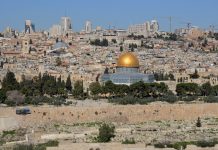
The Status Quo agreements regulate the jurisdiction of and access to key Christian sites in Jerusalem for Catholic, Orthodox and other Christian communities. Among those sites is the Church of the Holy Sepulchre, where tradition holds that Jesus was buried.
"There are huge areas of cooperation and good will, but what happened is very damaging for all of us," said Father Macora. The Franciscans "were not at all involved, but (the incident) is damaging for everybody," he emphasized.
The altercation broke out next to the traditional site of Jesus’ tomb during an annual Armenian Orthodox procession commemorating the fourth-century discovery of the cross believed to have been used to crucify Jesus.
The feud was sparked by the Greek Orthodox demand to post a monk inside the ancient structure built over the site of Jesus’ tomb. When the Armenian Orthodox refused to admit the Greek Orthodox monk, more Greek monks blocked their path, and the melee ensued.
Israeli police rushed in to separate the fighting monks, arresting one Armenian and one Greek.
No pilgrims present at the procession were injured, said Father Macora, and sporadic altercations should not affect visits to the church.
Although there have been such confrontations in the past — on Palm Sunday Armenian and Greek priests and pilgrims also exchanged blows — Father Macora, who is originally from Texas, said such altercations are "anomalies."
Disagreements about the Status Quo also have prevented the Israeli Ministry of Tourism from building an emergency exit and have prevented repairs from being carried out on the rooftop Ethiopian Orthodox monastery.
Father Macora said that as the negotiator for the Franciscans he tries to avoid such confrontations by careful study of the actual Status Quo agreements before making any claims.
The last serious confrontations involving the Franciscans and the Greek Orthodox occurred four years ago, he said, adding that in general the Franciscans are known to have good relations with both the Armenians and the Greeks.